AI Consulting Partners: Turning AI Experiments Into Enterprise Impact
written by Abhishek Uniyal
Share
Artificial intelligence is no longer limited to innovation teams and experimental budgets. It is now shaping boardroom priorities, product roadmaps, operational workflows, and customer experience strategies.
But there is a gap that many organizations are discovering the hard way.
It is relatively easy to launch an AI pilot. It is much harder to turn that pilot into a production-ready system that creates measurable business value across teams, processes, or products.
That is why the conversation around AI is shifting. The question is no longer whether a business should explore AI. The real question is how to move from promising experiments to enterprise impact.
A strong AI partner does more than recommend tools or build isolated proofs of concept. They help organizations align business goals, data systems, product strategy, and implementation so AI becomes a real operating capability rather than a short-lived initiative.
The AI Adoption Paradox
Businesses across sectors are investing in AI to automate work, improve decisions, and create more intelligent digital experiences. Yet many of these initiatives stall before they reach scale.
On paper, the opportunity looks straightforward. A team identifies a use case, tests a model, and sees early promise.
In practice, scaling AI is rarely that linear.
AI systems depend on clean data, strong integration patterns, workflow fit, governance controls, and product-level thinking. Without those pieces in place, even a good pilot can remain stuck in demo mode.
That is the paradox. Interest in AI is high. Experimentation is growing. But production success still lags behind.
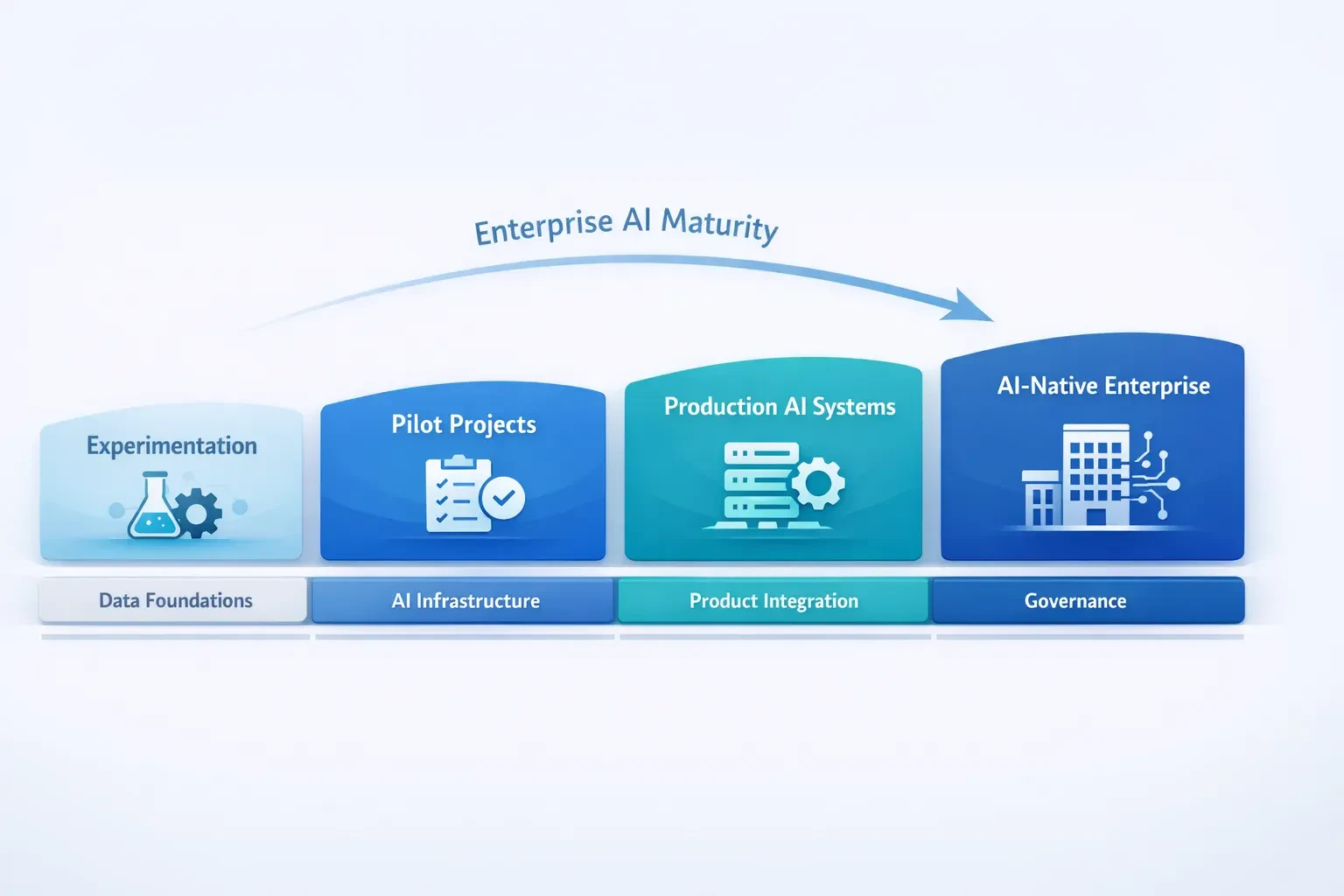
How organizations progress from isolated AI experiments to fully integrated AI-native systems.
Why AI Initiatives Often Stall
Most AI initiatives do not fail because the underlying model is weak.
They fail because the surrounding system is not ready.
A common problem is misalignment. Leaders may want AI because competitors are talking about it, but the business case is still vague. Without a clear objective tied to cost reduction, speed, revenue, customer experience, or operational efficiency, teams often end up building activity instead of impact.
Another issue is fragmented data. AI systems are only as useful as the foundations beneath them. If data is siloed, inconsistent, delayed, or poorly governed, the output quality suffers quickly.
There is also the challenge of productization. Many internal teams can build a proof of concept, but scaling requires architecture, monitoring, feedback loops, integration patterns, access controls, and adoption planning. That jump from prototype to production is where many initiatives lose momentum.
Finally, AI work often sits across multiple teams that do not naturally move in sync. Product, engineering, operations, compliance, and leadership may all have different expectations, timelines, and measures of success.
This is why AI is not just a technical implementation problem. It is a business systems problem.
And business systems need coordinated strategy and execution.
The Modern Role of an AI Consulting Partner
The role of AI consulting partners has changed significantly.
Traditional consulting models often focused on advisory work at the top and handoff at the bottom. That approach is increasingly ineffective in AI, where strategic decisions and implementation details shape each other constantly.
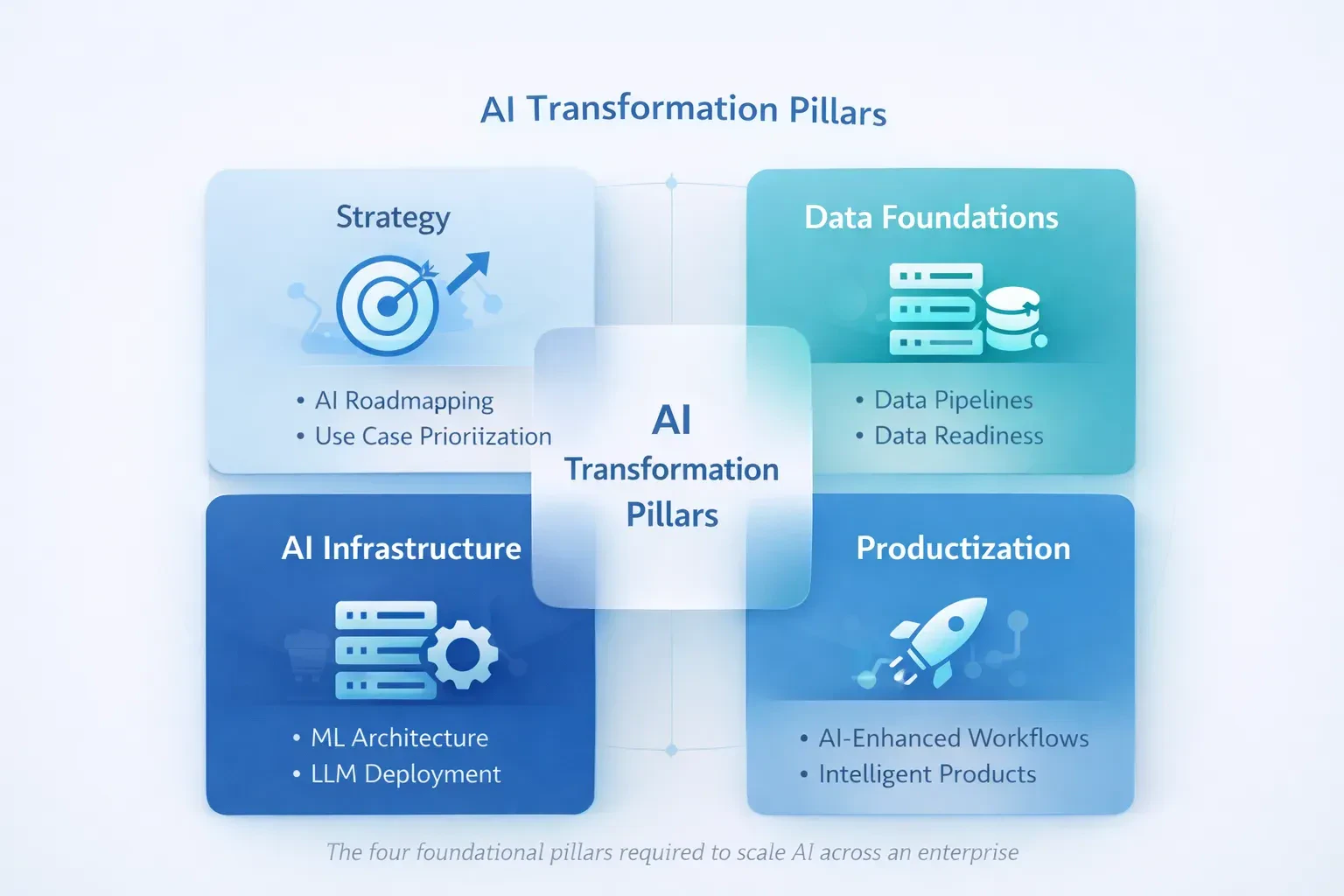
A modern AI consulting partner has to work across four connected layers.
Strategic AI Roadmapping
The first role is helping organizations identify where AI can create meaningful value.
This means separating signal from noise. Not every workflow needs AI. Not every use case should be prioritized. A strong consulting partner helps leaders focus on the initiatives that can create measurable outcomes, faster learning cycles, and defensible advantage.
That includes use case prioritization, ROI framing, business case design, and execution sequencing.
Data and AI Foundations
AI systems are only as reliable as the pipelines, architecture, and data operations supporting them.
A consulting partner should help assess readiness across data and AI foundations, including data availability, integration quality, governance, infrastructure, and orchestration. This foundation work is rarely glamorous, but it determines whether AI becomes scalable or brittle.
Productizing AI Capabilities
The next stage is turning isolated capability into usable systems.
That can mean internal copilots, workflow automation, knowledge retrieval systems, intelligent dashboards, recommendation engines, or customer-facing AI-native product features. The core idea is the same: the model alone is not the product. The surrounding experience, controls, and business fit are what create value.
Governance, Risk, and Responsible AI
As AI moves deeper into enterprise operations, governance matters more.
Organizations need controls around privacy, compliance, explainability, monitoring, human oversight, and safe usage. A serious AI consulting partner should account for these requirements from the start, not as an afterthought once the system is already in use.
The four foundational pillars required to scale AI across an enterprise.
What Businesses Should Look for in an AI Consulting Partner
Choosing the right AI consulting partner should be treated like a strategic decision, not a procurement checkbox.
The strongest partners bring product thinking, engineering depth, and business alignment together. They do not just advise from a distance or deliver to a fixed brief. They help shape what should be built, why it matters, and how it should evolve.
There are a few qualities worth looking for.
Product Thinking, Not Just Technical Delivery
AI creates value when it fits real user workflows and business decisions. That requires product thinking. Partners should understand not only models and infrastructure, but also adoption, usability, decision design, and workflow friction.
Prototype-to-Production Experience
Many firms can help create a polished demo. Fewer can build systems that survive real business conditions. Production-grade AI requires engineering discipline, architecture choices, monitoring, fallback logic, and operational reliability.
Collaborative Delivery Style
The best partnerships do not behave like black-box vendors. They work closely with internal teams, transfer knowledge, and build capabilities that stay useful after launch. That makes the business stronger over time, not more dependent.
Strategic and Technical Leadership
AI initiatives move faster when the people shaping the roadmap also understand the implementation consequences. Strategy without execution becomes slideware. Execution without strategy becomes expensive drift.
The right partner bridges both.
For businesses looking to build durable AI systems, this blend matters more than broad claims or oversized service catalogs.
How AI Consulting Partnerships Accelerate Innovation
The real advantage of a strong consulting partnership is not just faster delivery.
It is better decisions, better sequencing, and better odds of shipping something that actually matters.
When companies work with the right partner, they can move more quickly on high-value initiatives such as internal copilots, customer support automation, predictive analytics, intelligent search, document processing, recommendation systems, and AI-native product features.
The acceleration happens because the partner reduces uncertainty at multiple levels. They help define the right problem, avoid wasted effort, identify architecture tradeoffs early, and align implementation with business priorities.
This is especially important for enterprise teams that want to move fast without creating long-term technical debt or governance blind spots.
Many organizations experiment with AI, but far fewer succeed in scaling it across the enterprise.
A well-structured consulting partnership can also shorten time-to-value. Instead of spending months on disconnected experiments, organizations can prioritize a smaller set of high-impact use cases and move them toward measurable rollout.
That might mean helping a support team reduce response effort with AI-assisted workflows. It might mean enabling leadership with better forecasting and operational visibility. It might mean launching AI-powered features inside a software product to improve retention, differentiation, or user productivity.
In each case, the goal is the same: convert AI from isolated capability into repeatable business leverage.
The Future of AI Consulting
The consulting landscape around AI is changing quickly.
The next wave will not be defined by generic AI advisory. It will be defined by partners who can help businesses design AI-native operating models, agentic workflows, decision systems, and product experiences that evolve continuously.
As this shift happens, the role of the consulting partner expands.
They are no longer just advisors brought in for discovery workshops. They increasingly act as architecture partners, product collaborators, and transformation enablers who help organizations rethink how work gets done.
This matters because the future of enterprise AI will not be built around one model or one tool. It will be built around systems that connect data, context, workflow, decisioning, governance, and user experience.
That kind of transformation requires more than experimentation.
It requires thoughtful execution.
From AI Experiments to Enterprise Impact
The companies that win with AI will not necessarily be the ones that test the most tools.
They will be the ones that build the strongest bridge between opportunity and execution.
That bridge is made of strategy, product thinking, data readiness, architecture, governance, and operational follow-through. And for many organizations, the fastest way to build it is with the right AI consulting partner.
AI should not stay trapped in pilot mode.
With the right collaboration model, it can become a reliable business capability that improves how teams operate, how products evolve, and how decisions get made.
Let's Build Smarter AI Systems Together
If your team is exploring AI opportunities or trying to move beyond disconnected pilots, the next step is not more experimentation for its own sake.
It is a clearer path to production.
SynergyBoat helps organizations shape AI strategy, design scalable systems, and turn promising ideas into operational products.
Abhishek Uniyal
Co-founder & Builder
Abhishek helps lead SynergyBoat with a hands-on focus on engineering, delivery, and growth. He enjoys working closely with clients to turn early ideas into real, production-ready systems across AI, data, and modern product infrastructure. Over the years, he has worked across engineering, product building, and team leadership, helping shape products, teams, and execution from the ground up.
Outside of work, he enjoys badminton, basketball, swimming, travel, and exploring new gadgets, ideas, and places.